ALL AMERICAN RACING NETWORK
Sports | Sim Racing | February 15, 2026
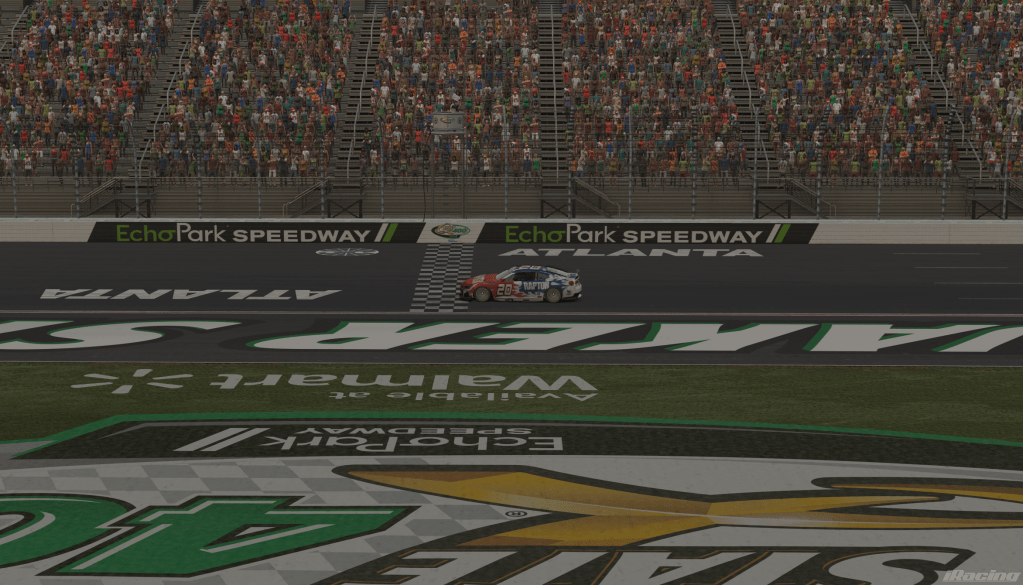
Hampton, GA. — Young Breaks Through in Race 2.
Race 2 of the All American Racing League season delivered a different kind of drama than the opener — less about a last-second pass and more about long-run control, strategic execution, and a late reshuffling of the front.
Over 136 laps, the race evolved from early dominance to late opportunity. When it ended, Justin Young stood in Victory Lane after charging from 13th on the grid, proving that patience and positioning can overcome early control.
Vadnais Sets the Pace
For much of the race, the story revolved around Gregory Vadnais.
Vadnais led 70 laps — more than half the event — asserting control over the middle portion of the race and establishing himself as the clear tempo-setter. His long-run pace was consistent, his car stable, and his ability to manage traffic put him in command for extended stretches.
If Race 2 had ended earlier, it likely would have belonged to him.
But in a 136-lap event, control does not always equal victory.
Young Times It Right
While Vadnais controlled the race’s rhythm, Justin Young controlled his positioning.
Starting 13th, Young methodically worked forward, avoiding major mistakes and staying within striking distance of the lead pack. He led just 10 laps, but they were the most important laps of the race.
When the opportunity opened late, Young capitalized — turning a steady climb into a decisive win.
It was not a dominant performance. It was a disciplined one.
And through two races, that kind of execution carries weight.
Etchepare Responds
After leading 31 laps in Race 1 before being wrecked out, Chris Etchepare needed a bounce-back performance.
He delivered.
Starting ninth and finishing second, Etchepare kept himself in contention all race long. He led one lap but, more importantly, maintained consistent pace across the full 136-lap distance.
The result reestablishes him as one of the most complete drivers in the field — fast enough to lead, steady enough to finish.
Combs Brings the Speed
Kameron M. Combs may not have won the race, but he produced the single fastest lap of the event — 0:29.144, the quickest time recorded in Race 2.
Starting 24th and finishing third, Combs executed one of the strongest advancement drives of the night. The speed is undeniable. If that pace aligns with track position in future races, he becomes a serious win threat.
Front-Row Fade and Late Movement
Polesitter Kevin E. Bullock showed early speed but ultimately settled for fourth after a high-incident afternoon. The pace was there; the execution over the full distance proved more difficult.
Zackery King rounded out the top five after leading 19 laps, showing early race strength before the balance of power shifted late.
🧾 Race Notes
Winner: Justin Young (Started 13th)
Second: Chris Etchepare
Third: Kameron M. Combs
Most Laps Led: Gregory Vadnais (70)
Fastest Lap: Kameron M. Combs — 0:29.144
Race Distance: 136 laps
What Race 2 Revealed
Through two races, the early championship themes are emerging:
Dominating laps does not guarantee victory.
Winning requires timing, not just pace.
Recovery drives matter.
Consistency is beginning to separate contenders from pure speed threats.
Race 2 didn’t create a runaway favorite — it tightened the field.
Two races in, the championship isn’t defined.
But it’s absolutely taking shape.
 All American Racing Network
Leave a comment